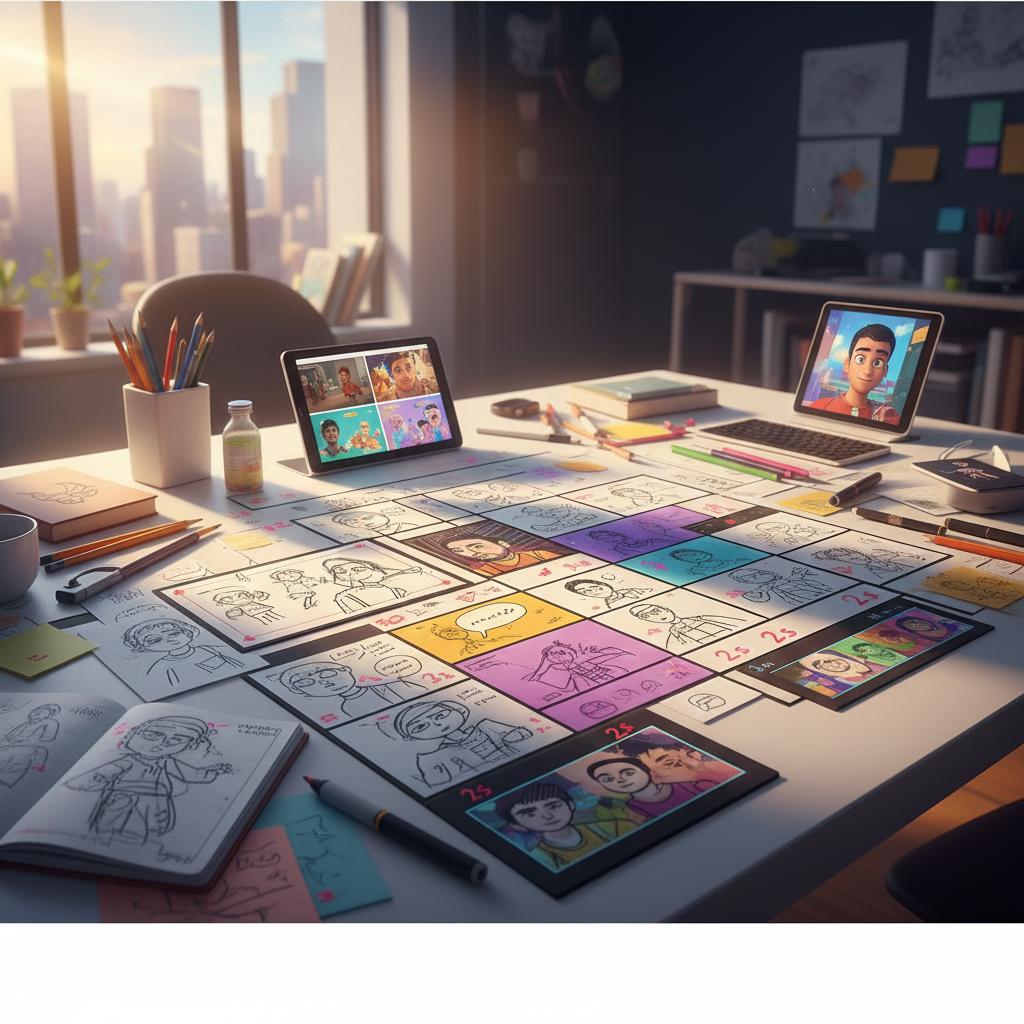
The world of animation is undergoing a transformative shift, with AI-driven techniques and procedural workflows redefining how creators bring stories to life. For students at Shaft Media Academy, understanding these trends is key to staying ahead in the dynamic field of animation. This article explores how AI and procedural methods are shaping modern animation, offering insights into their applications, benefits, and future potential.
The Rise of AI in Animation
Artificial intelligence is no longer a futuristic concept—it’s a core tool in today’s animation pipelines. AI is being used to streamline repetitive tasks, enhance creative output, and push the boundaries of what’s possible in storytelling.
1. Automating Repetitive Tasks
Animation often involves time-consuming tasks like rigging, keyframing, or lip-syncing. AI algorithms, particularly those based on machine learning, can automate these processes with remarkable precision. For example:
AI-Driven Rigging: Tools like Autodesk’s Maya with ML-based plugins can generate character rigs in minutes by analyzing skeletal structures and predicting joint placements.
Lip-Sync Automation: Software like Adobe Character Animator uses AI to match mouth movements to audio in real-time, reducing manual work for animators.
Motion Capture Enhancement: AI cleans up motion capture data, smoothing out imperfections and reducing the need for manual adjustments.
By handling these repetitive tasks, AI allows animators to focus on storytelling and creative expression, which are at the heart of animation.
2. AI for Creative Enhancement
Beyond automation, AI is becoming a creative partner. Generative AI models, such as those used in tools like Runway or DALL·E, can create concept art, textures, or even entire animated sequences based on text prompts. For instance:
Text-to-Animation: Tools like Kaiber or Genmo allow animators to input a script or description (e.g., “a dragon flying over a misty mountain”) and generate animated clips, which can serve as storyboards or rough drafts.
Style Transfer: AI can apply the visual style of one artwork (e.g., a Van Gogh painting) to an animated sequence, creating unique aesthetics with minimal effort.
Facial Animation: NVIDIA’s Audio2Face uses AI to generate realistic facial expressions from audio inputs, ideal for character-driven narratives.
These tools empower students to experiment with bold ideas, even with limited resources, making high-quality animation more accessible.
3. Real-Time Animation
AI is enabling real-time animation for gaming, virtual production, and live performances. Unreal Engine’s MetaHuman Creator, for example, uses AI to generate photorealistic characters that can be animated in real-time using simple inputs like webcam footage. This is a game-changer for projects requiring instant feedback, such as virtual reality experiences or interactive media.
Procedural Workflows: Efficiency Meets Creativity
Procedural workflows, which rely on algorithms to generate content systematically, are another cornerstone of modern animation. Unlike traditional methods that require manual asset creation, procedural techniques use rules and parameters to build complex scenes, environments, and effects efficiently.
1. Procedural Environment Creation
Tools like Houdini and Blender’s Geometry Nodes allow animators to create vast, detailed environments—think sprawling forests or futuristic cities—without modeling every element by hand. For example:
Houdini’s Procedural Systems: Animators can define rules (e.g., “place trees randomly but avoid overlapping”) to generate entire ecosystems. These systems are dynamic, meaning changes to parameters instantly update the scene.
Blender’s Geometry Nodes: These nodes let students create intricate patterns, scatter objects, or simulate natural phenomena like erosion, all within a node-based interface.
Procedural workflows save time and allow for rapid iteration, which is critical in fast-paced production environments.
2. Dynamic Simulations
Procedural methods excel in simulations like water, fire, or crowd behavior. For instance:
Fluid Simulations: Houdini’s fluid solvers can create realistic water or smoke effects by calculating physics-based interactions, reducing the need for manual animation.
Crowd Systems: AI-driven crowd simulations in tools like Massive or Golaem can animate thousands of characters with unique behaviors, perfect for epic battle scenes or bustling cityscapes.
These techniques give students the power to create complex, large-scale animations that would be impractical with traditional methods.
3. Modular Asset Creation
Procedural workflows enable modular design, where assets are built as reusable components. For example, a procedural building generator can create endless variations of structures by tweaking parameters like height, window style, or material. This approach is widely used in game development (e.g., No Man’s Sky’s procedurally generated planets) and is increasingly adopted in film and TV for scalable world-building.
The Synergy of AI and Procedural Workflows
When combined, AI and procedural workflows create a powerful synergy. AI can enhance procedural systems by predicting optimal parameters or generating variations based on learned patterns. For example:
AI-Optimized Procedural Content: In game development, AI can analyze player behavior and adjust procedural environments in real-time to enhance immersion.
Generative Procedural Animation: AI can generate procedural motion patterns (e.g., a flock of birds) that adapt to environmental changes, blending creativity with technical precision.
This synergy allows animators to produce high-quality content faster, making it ideal for tight deadlines or experimental projects.
Benefits for Shaft Media Academy Students
For aspiring animators, mastering AI-driven and procedural techniques offers several advantages:
Efficiency: Automating repetitive tasks and using procedural methods cuts production time, allowing students to focus on storytelling.
Accessibility: AI tools democratize animation, enabling students with limited resources to create professional-grade work.act: +91-92471 69695